In Part 1, I introduced the Prosci CLARC model and the five roles leaders need to play in any change process. The most challenging of those roles is Resistance Manager. This is where we spend Part 2.
Learning to Value Resistance
I am here to help you see the value in resistance. Resistance is a deeply human reaction to change. It is not a malfunction – it is a natural response.
This is something I learned from my colleague Jessy Kirkwood: resistance carries data for the project team. It provides information and feedback about what is unclear, where the blockages are, and where the contradictions lie. Think of it this way: a resistant team member is functioning like an audit on your change process. They are surfacing every contradiction, every gap, every step you skipped, every message that didn’t land. If you know how to read that signal, you gain something invaluable.
Visible resistance is manageable – and when handled well, it is genuinely valuable.
Resistance is the surface. What lies beneath it is emotion – and it is that emotion that shows up in behavior.
While change happens at the organizational level, the reaction always happens at the individual level. Every person on your team is processing the change through their own lens of history, role, relationships, and values.
This is the core challenge: a project team cannot sense and manage every individual emotional reaction. That requires leaders – people who are close enough to see what’s actually happening, and trusted enough to be heard.
Change is personal. Yours too. Everyone walks their own individual path through it. We are not at the same point. We don’t lose the same things. We don’t gain the same things.
The Diagnostic Framework: Not Knowing / Not Able / Not Willing
When someone “resists”, they may actually be experiencing one of three things:
- cognitive uncertainty,
- a skill or capacity gap, or
- emotional resistance.
The surface behavior – silence, avoidance, pushback – can look identical. But the root cause is completely different. And the intervention needs to match the root cause, not just the symptom.
Take someone who doesn’t speak up in a workshop. Same behavior – but three completely different explanations. They might be confused: the picture isn’t coming together for them, they don’t understand where they fit. They might be overwhelmed: they’re already at capacity, and this is one more thing landing on top of everything else. Or they might be angry: no one asked for their input, decisions were made without them, and silence is the only protest available.
Confused. Overwhelmed. Angry. Three different people, sitting in the same room, saying nothing. If you treat them the same way, you will miss all three. So before you act – read the emotions. Not the behavior. The emotion underneath it. That’s where the real state reveals itself.
Here’s the map that will help you:
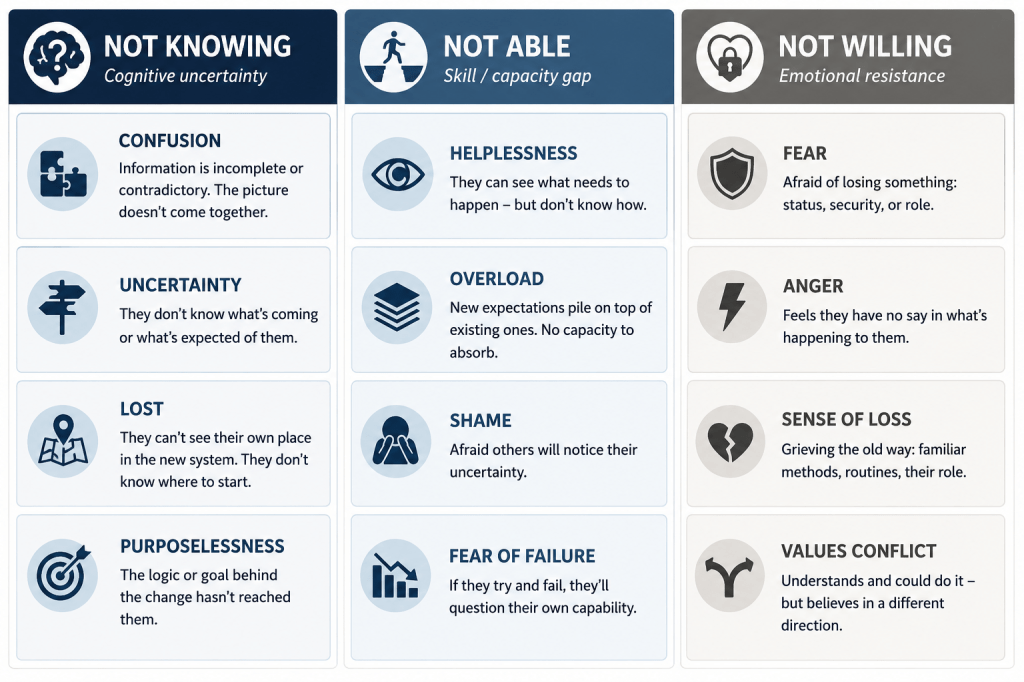
1. Not Knowing – Cognitive Uncertainty
The person doesn’t have enough context to make sense of what’s happening. The information they’ve received is incomplete, inconsistent, or simply hasn’t reached them yet. From the outside, it can look like resistance – when what’s actually happening is disorientation.
- Confusion – the information they’re receiving is contradictory or incomplete. The picture doesn’t come together. They can’t connect the dots.
- Uncertainty – they don’t know what is expected of them, or what comes next. The goal is unclear. The timeline is unclear. Their role in it is unclear.
- Lost – they can’t find their own place in the new system. They don’t know where to start, or what their job actually looks like on the other side of this change.
- Purposelessness – the logic or purpose behind the change hasn’t reached them. They understand that something is changing. They don’t understand why it matters.
What leaders typically see: a wave of questions in the best case. In the worst case: hallway conversations, side comments, and corridor skepticism that no one reports back to the project team – because no one even knows they’re happening.
2. Not Able – Skill or Capacity Gap
The person understands the change. They may even support it. But they don’t have the skills, the time, the resources, or the confidence to actually make it happen. From the outside, it can look like avoidance, passive compliance, or even lack of commitment – when what’s actually happening is something else entirely.
- Helplessness – they can see what needs to change, but don’t know how. The training hasn’t arrived. The guidance isn’t there. They’re waiting for something that hasn’t been given to them.
- Overload – expectations are increasing, and there’s no room to absorb them. During a new system rollout they may be running two systems in parallel. Nobody took anything off their plate before adding more.
- Shame – they’re afraid others will notice their uncertainty. So they go quiet. They don’t ask questions. They nod in meetings and struggle alone afterward.
- Fear of failure – they sense they’re not yet comfortable in the new environment, that their skills aren’t there yet. This often manifests as quiet resistance — procrastination, withdrawal, passivity.
What leaders typically see: on the surface, it looks like disengagement. Someone who used to be reliable suddenly misses deadlines, avoids conversations, or gives vague answers. They’re present – but not really there. In the worst case, they comply visibly while finding workarounds to avoid using the new system altogether.
3. Not Willing – Emotional Resistance
This is the most complex, the most misread, and the hardest to handle. The person understands the change. They may have the capability to make it happen. But something emotional is blocking them. And that something is almost always one of these four things:
- Fear – of losing something that matters. Status. Safety. Role. Control. The sense of being valued and needed. Fear is the most common emotional driver of resistance — and the most invisible. It rarely announces itself as fear. Instead, it shows up as over-caution, excessive questioning, sudden reluctance, or withdrawal.
- Anger – at not being consulted. People who feel that change is being done to them, rather than with them, get angry. This is not unreasonable. Angry people are engaged. They care.
- Sense of loss – grieving what’s being left behind. Change always involves loss — of familiar processes, comfortable routines, established relationships, and in many cases, of a professional identity that took years to build. This is grief. And grief has its own timeline.
- Values conflict – a genuine difference in direction. This is the rarest form — and also the most difficult to resolve. The person understands the change fully. They have the capability to execute it. But they fundamentally disagree with the direction. I’ve seen this most acutely in transitions where deep local expertise was being moved to a centralized function. The people affected weren’t resisting the process. They were resisting what the change said about their professional identity — about what kind of work has value, and where it belongs.
What leaders typically see: it depends on the emotion. Fear looks like over-caution and excessive questioning. Anger looks like vocal pushback – or pointed silence. Grief looks like someone who keeps referencing how things used to work. Values conflict looks like someone who is polite, professional, and completely disengaged. The common thread: none of them announce what’s actually happening inside. You have to look for it.
Resistance intensifies at predictable points
There are predictable points along the change journey where resistance intensifies. These are not random reactions – they are identifiable emotional patterns.
Before leaving the current state, typical reactions include confusion, uncertainty, purposelessness, a sense of being lost. The root cause is rarely just a lack of information. More often, people understand the change intellectually – but they can’t yet see where they belong in the new picture. Identity and role feel uncertain before logic even gets a chance to help.
During the transition from present to future, what typically surfaces is fear, anger, helplessness, and anxiety about failure. The dominant experience here is loss of control – over outcomes, over status, over the familiar rhythm of work.
Upon arriving at the future state: overwhelm, a quiet sense of grief, and sometimes a clash of values. This surprises leaders. They expected relief. Instead, they find that even successful arrival comes with mourning what was left behind – and pressure from new expectations that haven’t yet become natural.
The Same Silence. Three Completely Different Problems.
Resistance always points to a gap – and that gap generates emotion. A gap in knowledge, in understanding, in willingness. If you diagnose well, you can intervene precisely.
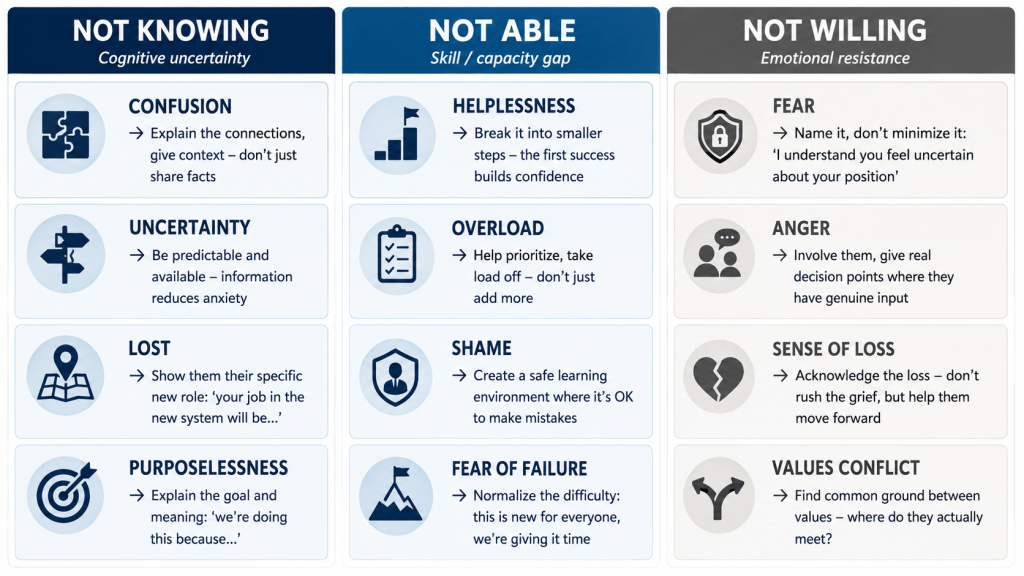
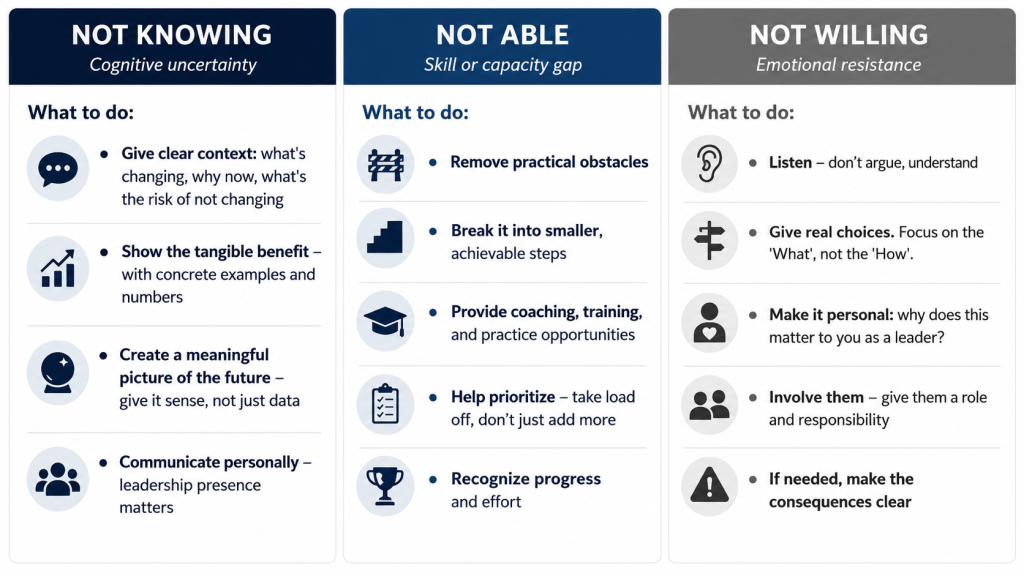
If you see that the team is in a Not Knowing state, put on the Communicator hat. Give clear context: what is changing, why now, and what is the risk of not changing. Show the tangible benefit – with concrete examples and real numbers. Give them a meaningful picture of the future – don’t just communicate data, communicate purpose. And where you can, communicate through the direct manager. That’s who they trust.
If you see that the individual is Not Able, remove the obstacle. Help them understand the change and break it into smaller, achievable steps. Provide coaching and practice opportunities. Help them prioritize – take something off their plate, don’t just add new expectations. Acknowledge their progress and effort — and celebrate the wins.
If you see that the individual is Not Willing, build trust. Listen to their perspective – don’t argue, understand. Give real choices: show them the destination, the “what”, but involve them in shaping the “how”. Make it personal: tell them why this matters to you as their leader. And sometimes – when necessary – the consequences of continued non-participation need to be made clear as well.
The key: don’t use the same approach for every form of resistance.
Often, the answer is not stronger communication pressure – it’s a more precise intervention. Before you intervene, diagnose. If you can’t answer “What gap I need to fill” – you’re not ready to take actions.
This three-part series is based on a webinar I delivered for PMI Budapest in March 2026.
In Part 1, we looked at leadership. The five CLARC roles every leader needs to play during change — and why resistance almost never starts with difficult people. It starts with unprepared leaders.
In Part 2, we looked at diagnosis. The same behavior — silence, avoidance, pushback — can be rooted in three completely different causes: cognitive uncertainty, a skill or capacity gap, or emotional resistance. If you misread the emotion, you will choose the wrong intervention.
Part 3 is about what to do once you’ve made the diagnosis.
 HOME
HOME 