In Part 1, we looked at leadership. The five CLARC roles every leader needs to play during change — and why resistance almost never starts with difficult people. It starts with unprepared leaders.
In Part 2, we looked at diagnosis. The same behavior — silence, avoidance, pushback — can be rooted in three completely different causes: cognitive uncertainty, a skill or capacity gap, or emotional resistance. If you misread the emotion, you will choose the wrong intervention.
Part 3 is about what to do once you’ve made the diagnosis.
The ADKAR Model: A Map for Individual Change
Diagnosis tells you where someone is stuck. But then what?
The Prosci ADKAR model gives me a map for what the journey forward actually looks like. It describes five stages that every individual needs to move through for a change to genuinely stick. They are sequential — and if someone is stuck at one stage, moving to the next before addressing the blockage is a waste of effort.
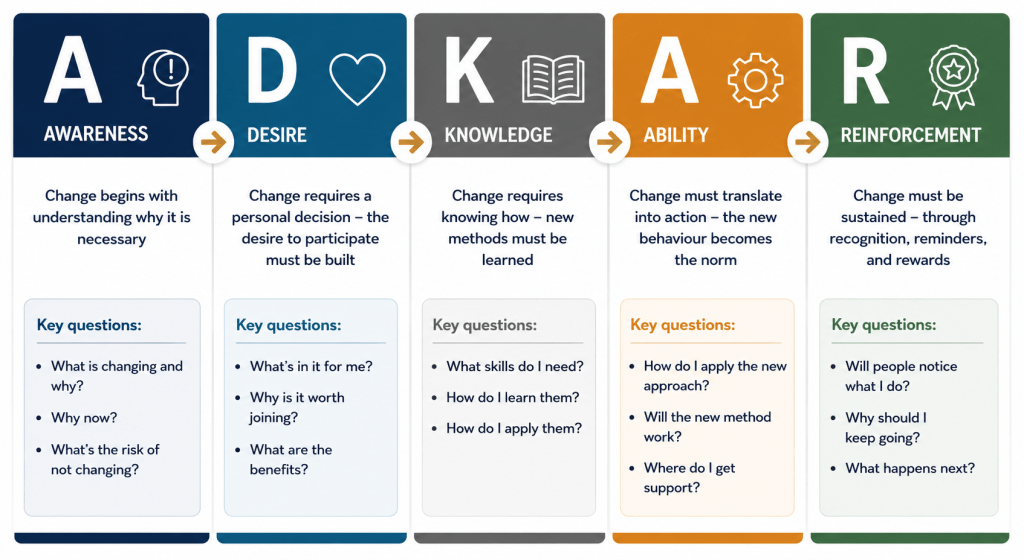
A – Awareness. The individual understands why the change is happening. Not just that it’s happening — why. What’s the problem this is solving? What’s the risk of not changing? Without this foundation, nothing else holds.
D – Desire. The individual has made a personal decision to support and engage with the change. This cannot be manufactured or coerced. It has to be built — through meaningful involvement, honest conversation, and a clear answer to the question: what’s in this for me?
K – Knowledge. The individual knows how to change. This is where training and clear guidance become relevant — but only once Desire is in place. Training someone who doesn’t want to be there is largely wasted effort.
A – Ability. The individual is able to apply the new knowledge in practice. There’s a significant gap between knowing and doing — and this is where coaching, practice, and ongoing support become critical.
R – Reinforcement. The new behavior is being recognized, rewarded, and sustained. Without reinforcement, people revert. The old patterns are comfortable. The new ones require continued effort.
When someone is resisting, they’re stuck somewhere on this journey. Your job isn’t to push them faster through the process — it’s to identify exactly where they are, and give them what they need to take the next step.
How CLARC and ADKAR Connect
At this point you might be asking: how do the five leadership roles from Part 1 relate to the individual’s change journey?
The answer is simple.
The Communicator builds Awareness — by explaining the context, the why, and the stakes. Without this, the individual can’t even start the journey.
The Liaison supports Awareness and Reinforcement — by ensuring information flows in both directions, and that feedback from the team reaches the project. What people are actually feeling needs to get back to the people who can act on it.
The Advocate builds Desire — because when a leader visibly believes in the change, it gives others permission to believe in it too.
The Resistance Manager addresses Desire and Reinforcement — by diagnosing where the individual is stuck and creating the conditions for re-engagement.
The Coach develops Knowledge and Ability — not just telling people what to do, but helping them actually learn how to do it differently, on the job.
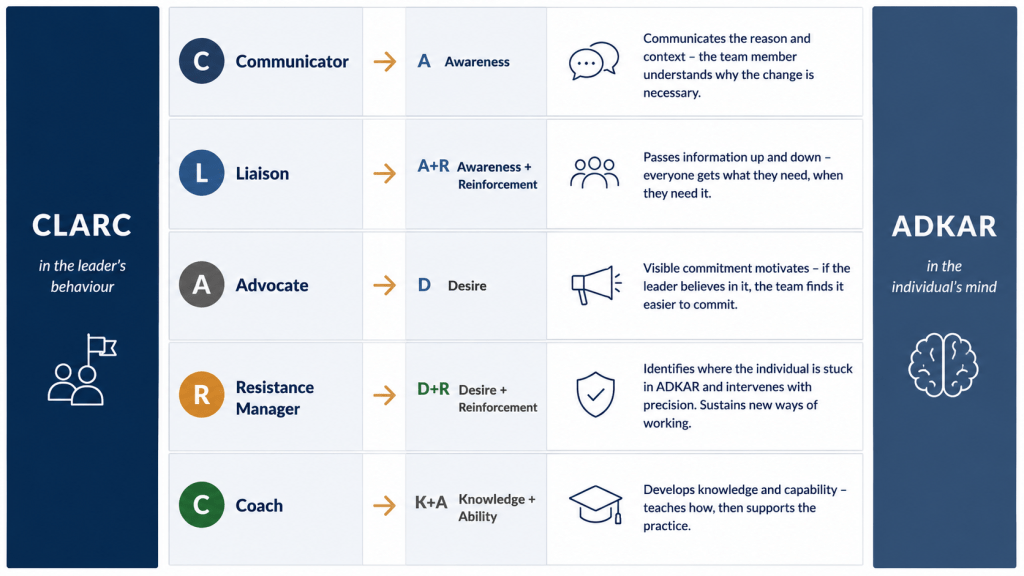
ADKAR happens inside the individual. CLARC happens in the leader’s behavior. Change happens when the two meet.
Your Resistance Management Plan: Four Questions
Theory matters. But what you actually need is something you can use in the middle of a real project, with real people, under real pressure.
I use four questions. They’re simple. They consistently surface what’s actually happening under the surface.
1. What am I seeing?
Not Knowing, Not Able, or Not Willing — which specific pattern? The behavior might look the same — silence, delay, avoidance — but the underlying state is completely different. Don’t assume. Observe more carefully. Ask more carefully.
2. Why is this happening?
What’s the real root cause? Is it an information gap? A skills gap? A fear of losing something important? A values conflict? A sense of not being consulted?
Most leaders skip this step. They observe the behavior and jump straight to intervention. The result is a misaligned response that doesn’t land — and often makes things worse. Resist the temptation to assume. Ask. Have the conversation. The real reason is almost always different from the obvious one.
3. How will I respond?
Not in general terms. Specifically: who will you speak to, and when? What will you say? What will you take off their plate? Where will you give them a genuine decision point? What will you commit to following up on?
4. Did it work?
What changed? Is the engagement different? Is the behavior shifting? If the intervention didn’t work, the diagnosis was probably off. Go back and look again — not at the behavior, but at the root cause.
This four-question cycle is not a process. It’s a habit of mind. If you run through it for every key stakeholder before every major milestone, you will see the resistance coming before it becomes a crisis.
Three Things Worth Remembering
Resistance is a signal, not an obstacle. It tells you where the understanding, the motivation, or the capability is missing. If you read it well, it can actually accelerate your project — because it shows you exactly where to focus your energy.
There is a methodology. The CLARC model and ADKAR are not abstract frameworks. They are practical thinking tools for leadership decisions. Anyone can learn them. But applying them well takes time, experience, and genuine curiosity about what’s happening for the people in front of you.
And managing resistance measurably increases the odds of success:
6× greater likelihood of meeting project objectives
5× greater likelihood of staying on budget
2× greater likelihood of staying on schedule
These are the returns on investing in the human side of change.
A Final Thought
Change is a human process. The leader’s job is not to manage the change — it’s to accompany people through it.
Resistance will always be part of that journey. The people who push back, who ask hard questions, who slow things down — they are not your problem. They are your feedback loop.
Learn to read them well.
What does your resistance management plan look like right now — and when did you last update it?
This three-part series is based on a webinar I delivered for PMI Budapest in March 2026.
CLARC and ADKAR are Prosci methodologies. The Not Knowing / Not Able / Not Willing framework is my own.
 HOME
HOME 